
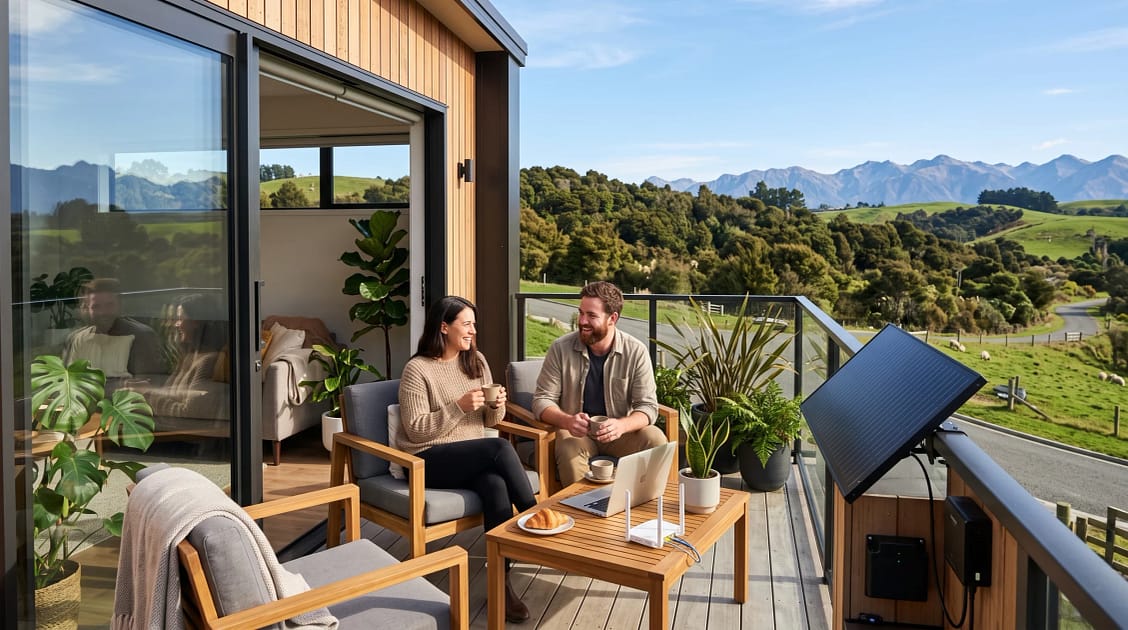
Quick Take
Plug-in solar could become one of the biggest changes to home energy in New Zealand.
Already transforming homes and apartments across Europe and gaining momentum in Australia, these compact solar systems allow households to generate electricity simply by plugging approved solar panels into a standard power outlet.
While New Zealand currently restricts these systems, regulators are actively reviewing the rules. If approved, plug-in solar could make renewable energy more affordable for renters, apartment owners and anyone unable to install traditional rooftop solar.
This guide explains how the technology works, why current regulations exist, what’s changing, how much you could save and whether plug-in solar is likely to become part of New Zealand’s energy future.
A New Chapter for Home Solar
For decades, rooftop solar has followed a familiar formula.
You hire an installer. They assess your roof, install multiple panels, connect an inverter, complete electrical work, arrange inspections, and the system becomes part of your home’s wiring.
It’s an excellent solution for many homeowners.
But it isn’t practical for everyone.
Millions of people live in rental properties, apartments, townhouses or homes where rooftop installations simply aren’t possible. Others may only want to reduce daytime electricity use without investing tens of thousands of dollars.
That’s where plug-in solar enters the conversation.
Instead of permanently wiring solar panels into your home’s electrical system, these systems are designed to connect through an approved microinverter and plug into a standard power outlet.
Think of it as the difference between installing a built-in dishwasher and plugging in a portable appliance.
Energy Insight: Expanding Access to Solar: The technology isn’t replacing traditional rooftop solar. Instead, it’s creating a simpler entry point into renewable energy.
What Is Plug-In Solar?
Plug-in solar, sometimes called balcony solar, plug-and-play solar or mini solar, is a compact solar system designed to generate electricity for immediate household use.
A typical system includes:
| Component | Purpose |
|---|---|
| Solar panel | Generates electricity from sunlight |
| Microinverter | Converts DC electricity into household AC power |
| Mounting system | Secures the panel safely |
| Approved connection cable | Connects the inverter to a power outlet |
Rather than sending electricity directly to the national grid, the electricity is first used by appliances already operating in your home.
For example:
- Refrigerator
- Wi-Fi router
- Television
- Laptop
- Phone chargers
- Aquarium pump
- Home office equipment
Because these appliances consume electricity continuously throughout the day, much of the solar energy is used instantly before any excess could flow elsewhere.
This concept is known as self-consumption, and it’s the key to why these systems can reduce electricity bills.
How Does It Work?
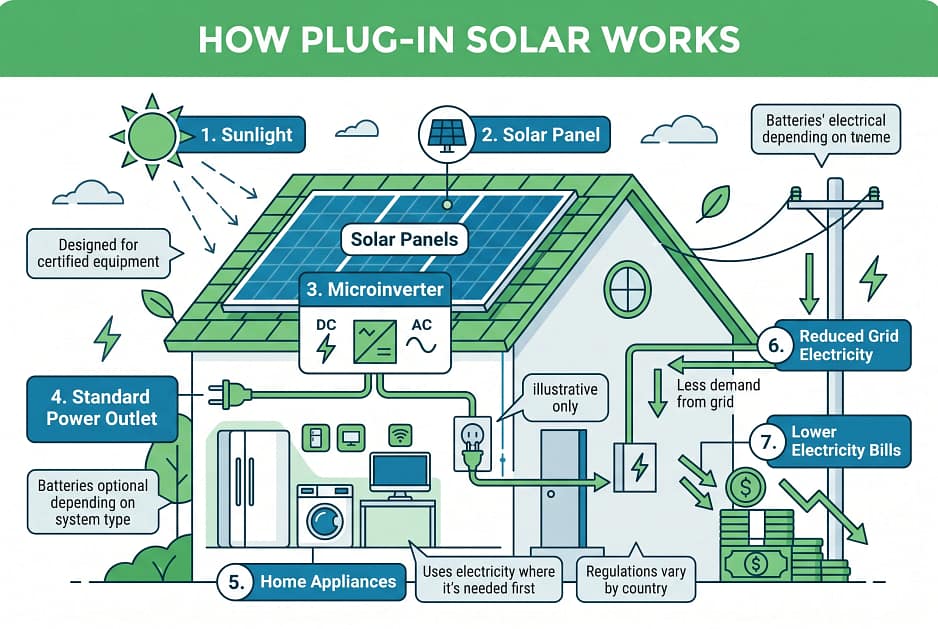
Imagine your home as a small river.
Normally, electricity flows in one direction:
Grid → Home → Appliances
When plug-in solar is added, sunlight creates another stream flowing into that river.
Now the flow becomes:
Sun → Solar Panel → Microinverter → Home Appliances
If your refrigerator needs 200 watts and your solar panel is producing 200 watts, your refrigerator effectively runs on solar power during that period.
If your home needs more electricity than the panel can provide, the grid simply supplies the difference.
The transition happens automatically.
No switches.
No batteries.
No manual intervention.
Why Doesn’t the Power Just Flow Everywhere?
One of the biggest misconceptions is that plug-in solar somehow “pushes electricity backwards” into every circuit.
In reality, electricity follows demand.
Your home’s appliances consume electricity continuously.
The solar system simply supplies part of that demand first.
Only if production exceeds consumption does excess energy have the potential to flow toward the grid, which is one reason regulators are developing technical standards for export limits and approved equipment.
Why Is Plug-In Solar Currently Restricted in New Zealand?
New Zealand’s electrical regulations were developed long before compact plug-in solar systems became available.
Traditional rooftop solar assumes:
- Licensed installation
- Permanent wiring
- Electrical inspection
- Approved grid connection
- Export management
Plug-in solar challenges those assumptions.
Regulators have raised questions about:
Grid Safety
If thousands of homes began exporting electricity unexpectedly, could local networks manage it safely?
Modern approved microinverters are designed with anti-islanding protection, automatically shutting down during power outages, but regulations must ensure all equipment meets consistent safety standards.
Electrical Standards
Should every household socket be suitable?
Should dedicated outlets be required?
Should plug types change?
Should export limits apply?
These technical questions are being evaluated to ensure systems remain safe for homeowners, neighbours and electricity workers.
Product Quality
Like any rapidly growing technology, not all products are created equal.
Countries that have embraced plug-in solar generally require certified:
- Panels
- Inverters
- Connectors
- Safety shutdown systems
This helps prevent low-quality equipment entering the market.
Why Interest Is Growing So Quickly
Electricity prices have risen steadily across much of the world.
At the same time:
- Solar panels have become dramatically cheaper.
- Microinverters have become more efficient.
- Apartments are becoming more common.
- More people work from home.
- Renting continues to increase.
These trends have created a perfect environment for compact solar systems.
Many households don’t need a 10-kW rooftop installation.
They simply want to offset the electricity used by everyday appliances during daylight hours.
The Home Office Effect
Working from home has quietly changed electricity use.
Instead of an empty house during the day, many homes now have:
- Computers
- Multiple monitors
- Internet routers
- Air conditioning or heating
- Coffee machines
- Printers
These devices run exactly when solar panels produce the most electricity.
Why Traditional Rooftop Solar Isn’t Right for Everyone
Traditional rooftop systems remain an excellent investment for many homeowners, but they also come with significant barriers.
| Challenge | Rooftop Solar | Plug-In Solar |
|---|---|---|
| Upfront cost | High | Lower |
| Installation | Electrician required | Designed for simplified installation (subject to NZ regulations) |
| Roof ownership | Required | Not always |
| Suitable for renters | Rarely | Potentially yes |
| Easy to relocate | No | Yes |
| Apartment friendly | Difficult | Often suitable |
For many people, plug-in solar isn’t about replacing rooftop solar.
It’s about finally having access to solar power where none existed before.
That makes plug-in solar especially attractive for remote workers.
That makes plug-in solar especially attractive for remote workers.
The Rise of Balcony Solar Around the World

Across Europe, a quiet energy revolution has been unfolding.
Instead of waiting years to install rooftop systems, people began placing one or two solar panels on:
- Apartment balconies
- Garden fences
- Small sheds
- Courtyards
- Garage walls
These modest systems don’t power an entire home.
They don’t need to.
Their purpose is simple:
Reduce the amount of electricity purchased from the grid every sunny day.
When multiplied across hundreds of thousands of homes, the impact becomes surprisingly significant.
A Different Way of Thinking
Traditional solar asks:
“How can I power my entire house?”
Energy Insight: A Different Way to Think About Solar
Balcony solar asks a different question:
“How can I stop buying electricity for the appliances that run all day?”
Energy Insight: A Different Way to Think About Solar
It’s a subtle shift in thinking, but one that’s helping more households participate in renewable energy, regardless of whether they own a home.
Germany’s Balcony Solar Revolution
Long before plug-in solar became a topic of discussion in New Zealand, it was quietly transforming apartment buildings and homes across Germany.
What began as a niche idea has grown into one of the world’s most successful examples of small-scale renewable energy.
Today, millions of Germans have embraced Balko Kraftwerk, literally meaning balcony power station. These compact systems typically consist of one or two solar panels paired with a certified microinverter that feeds electricity into the home.
Unlike large rooftop installations designed to maximize energy production, balcony solar is built around a different philosophy:
Energy Insight: Small Solar, Big Impact: Produce enough clean electricity to cover everyday daytime consumption.
That simple shift has made solar accessible to people who were previously excluded from the renewable energy transition.
Why Germany Embraced Balcony Solar
Several factors helped drive widespread adoption:
- Rising electricity prices
- High apartment living
- Strong public support for renewable energy
- Clear safety standards
- Affordable solar equipment
- Simple registration processes
For many households, installing one or two panels became almost as routine as buying a new appliance.
Rather than waiting years to recover the cost of a large rooftop system, families could begin reducing electricity bills almost immediately with a much smaller investment.
Lessons New Zealand Can Learn
Germany’s experience offers several valuable lessons:
| Lesson | Why It Matters for NZ |
|---|---|
| Clear regulations encourage adoption | Consumers gain confidence when rules are straightforward. |
| Certified equipment improves safety | Approved microinverters and connectors minimise electrical risks. |
| Smaller systems still make a difference | Even modest generation can reduce daytime grid consumption. |
| Renters can participate | Renewable energy becomes more accessible beyond homeowners. |
| Simplicity drives uptake | Lower barriers encourage wider participation. |
Global Energy Insight: The biggest takeaway isn’t that Germany copied traditional rooftop solar. It’s that Germany created a pathway for a different type of solar system with rules tailored to its unique characteristics.
Australia’s Next Step
Australia has long been recognized as one of the world’s solar leaders.
With abundant sunshine and millions of rooftop systems already installed, it may seem surprising that plug-in solar has only recently gained momentum.
The reason is simple.
Existing electrical regulations were written before plug-and-play systems existed, much like New Zealand’s current framework.
Recognizing growing consumer interest, Australian regulators have been working with industry experts to develop standards allowing approved plug-in solar systems while maintaining electrical safety.
Although implementation varies between jurisdictions, the direction is clear:
Make small scale solar more accessible without compromising safety.
For New Zealand, Australia’s experience is especially valuable because both countries share similar electrical standards and regulatory approaches.
Why Australia Matters to New Zealand
Australia often acts as a testing ground for products that later enter the New Zealand market.
Manufacturers already design many electrical products to comply with both Australian and New Zealand standards.
If certified plug-in solar becomes widely available across Australia, it’s likely New Zealand consumers will soon ask:
“Why can’t we have the same option?”
What’s Changing in New Zealand?
Interest in plug-in solar has grown rapidly over the past year.
Energy companies, consumer groups, industry organizations and regulators are increasingly discussing how New Zealand can safely accommodate these systems.
While no nationwide approval has yet been finalized, the conversation has shifted noticeably.
Instead of asking:
“Should plug-in solar exist?”
NZ Energy Insight: Moving From Restriction to Regulation
The discussion is increasingly becoming:
“What standards are needed to allow it safely?”
NZ Energy Insight: Moving From Restriction to Regulation
That distinction is significant.
It suggests the focus is moving from prohibition toward practical implementation.
What Could Future Rules Include?
Although nothing is confirmed, future requirements could include:
- Certified microinverters
- Approved connection cables
- Maximum system size
- Anti-islanding protection
- Export limits
- Product certification
- Installation guidance
- Registration requirements
These measures would be designed to balance consumer access with network safety.
Eco TIGA Tip: Check Before You Buy When regulations are finalized, we’ll update this guide with the latest requirements so you can make informed decisions before purchasing any equipment.
Who Could Benefit Most?
One of plug-in Solar’s greatest strengths is its flexibility.
Unlike traditional rooftop systems, it’s not limited to detached homeowners.
Renters
Renters are perhaps the biggest potential winners.
Many tenants want to reduce electricity costs but can’t install permanent rooftop systems.
A portable or removable solar setup could provide a practical alternative, subject to landlord approval and future regulations.
Potential benefits include:
- Lower daytime electricity use
- Portable investment
- Easy relocation when moving
- No permanent roof alterations
Related reading: Can Renters Use Solar Power in New Zealand? (2026 Guide)
Apartment Owners
Apartment residents often have little control over shared roofs.
Balcony solar changes the conversation.
Where suitable outdoor space exists, residents may be able to generate part of their own electricity without requiring a full building-wide solar project, depending on future rules and body corporate requirements.
Homeowners
Homeowners who already have rooftop solar may not need plug-in systems.
However, households without suitable roofs could benefit.
Examples include:
- Heavy tree shading
- Heritage homes
- Older roofs nearing replacement
- Budget-conscious households
- Small energy users
For these homes, a compact plug-in system could offer a lower-cost entry into solar energy.
Holiday Homes
Many New Zealand holiday homes have modest daytime electricity needs.
A small solar system could help offset:
- Refrigerators
- Security systems
- Internet connections
- Ventilation systems
Although savings may be smaller than for a permanent residence, the concept remains appealing for reducing ongoing operating costs.
Tiny Homes
Tiny homes often prioritize energy efficiency from the outset.
Plug-in solar could complement:
- Portable batteries
- Solar generators
- Energy-efficient appliances
Its portability also aligns well with homes designed to be relocated.
What Could Plug-In Solar Cost?
Final New Zealand pricing will depend on local suppliers, exchange rates and regulatory requirements.
However, international pricing provides a useful guide.
| System Size | Typical Components | Indicative Price (NZD)* |
|---|---|---|
| 400W | Panel + microinverter | $700 to $1,200 |
| 800W | Two panels + inverter | $1,200 to $2,000 |
| 1,600W | Four panels + inverter | $2,000 to $3,500 |
Indicative estimates based on overseas market trends. Actual New Zealand pricing may differ.
How Much Could You Save?
Savings depend on several factors:
- Sunlight hours
- Electricity prices
- Panel orientation
- Household daytime usage
- System size
Homes that consume electricity during daylight hours are generally best placed to benefit.
Example Scenarios
| Household | Potential Benefit |
|---|---|
| Remote worker | High |
| Couple at work all day | Moderate |
| Stay-at-home parent | High |
| Small apartment | Moderate to High |
| Holiday home | Low to Moderate |
| Home office | High |
The key isn’t producing all your electricity.
It’s reducing the amount you buy from the grid when the sun is shining.
Plug-In Solar vs Portable Power Stations
This is one of the most common questions readers are likely to ask.
While both use solar panels, they solve different problems.
| Feature | Plug-In Solar | Portable Power Station |
|---|---|---|
| Reduces electricity bills | Yes | No (indirectly) |
| Stores energy | No | Yes |
| Backup during outages | Usually no | Yes |
| Portable | Moderate | High |
| Grid-connected | Yes | Usually no |
| Camping use | Limited | Excellent |
Think of them as complementary rather than competing technologies.
A household might use plug-in solar for everyday bill savings and a portable power station for emergency backup or camping.
Portable Power Calculator: Estimate the battery capacity you need for camping, emergencies or off-grid adventures.
Should You Wait or Buy Something Else?
If plug-in solar isn’t yet available in New Zealand, should you simply wait?
Not necessarily.
For some households, other technologies are already delivering excellent value.
| Your Situation | Best Option Today |
|---|---|
| Frequent power outages | Portable power station |
| Off-grid cabin | Solar generator |
| Homeowner with suitable roof | Traditional rooftop solar |
| Camper or traveller | Folding solar panels |
| Renter wanting lower power bills | Monitor plug-in solar developments while considering portable solar solutions |
Eco TIGA Tip: Match the Technology to Your Lifestyle: Choosing the right technology depends on your goals, budget and living situation.
Sometimes the best investment is available today. Sometimes it’s worth waiting for a technology that’s a better fit.
Safety Comes First
One reason plug-in solar has attracted regulatory attention is safety.
Modern certified systems incorporate several important protections, including automatic shutdown if the grid loses power, helping to protect line workers during outages.
However, safe operation depends on more than just the equipment itself.
Future New Zealand regulations are likely to emphasize:
- Certified components
- Weather-resistant connections
- Correct mounting methods
- Approved microinverters
- Compliance with Australian and New Zealand electrical standards
- Clear installation guidance
Consumers should be cautious of imported products that do not meet local certification requirements, even if they appear cheaper.
Eco TIGA Tip: Don’t Choose Solar on Price Alone “A lower purchase price isn’t always a better deal. Certification, warranty support and compliance with New Zealand standards are just as important as upfront cost.”
Myth vs Fact
As plug-in solar gains attention around the world, it’s also attracting plenty of misconceptions. Let’s separate the myths from the reality.
| Myth | Fact |
|---|---|
| Plug-in solar is just a gimmick. | Millions of systems are already operating successfully across Europe, demonstrating that small-scale solar can meaningfully reduce daytime electricity use. |
| It can power an entire home. | Most systems are designed to offset part of a household’s daytime consumption rather than replace all grid electricity. |
| Anyone can buy any system online and plug it in safely. | Safe operation depends on certified equipment and compliance with local regulations. Future New Zealand requirements are likely to specify approved products and installation practices. |
| It replaces rooftop solar. | Plug-in solar complements rooftop solar by providing an option for people who cannot install a permanent system. |
| You need batteries for it to work. | No. Most plug-in systems operate without batteries, supplying electricity directly to appliances while the sun is shining. |
| It works during a power cut. | Generally no. Certified grid-connected systems automatically shut down during outages to protect electricity workers. |
Is Plug-In Solar Right for You?
There isn’t a single answer that suits everyone.
The best choice depends on your home, your budget, and how you use electricity.
- Rent your home and want a removable solar option
- Live in an apartment with suitable outdoor space
- Work from home during daylight hours
- Want to reduce electricity bills without installing a full rooftop system
- Prefer a smaller upfront investment
- Are comfortable following future New Zealand regulations
- Already have a large rooftop solar system
- Need backup power during blackouts
- Have heavy evening electricity use with little daytime demand
- Have no suitable outdoor location for panels
The Future of Plug-In Solar in New Zealand
Although plug-in solar is not yet widely available under New Zealand’s current framework, momentum is clearly building.
Several factors are pushing the conversation forward:
- Rising electricity prices
- Advances in solar technology
- Falling equipment costs
- Growing interest from renters
- International success stories
- Australia’s move toward approval pathways
New Zealand has a long history of embracing practical renewable energy solutions.
From home insulation to heat pumps and rooftop solar, technologies that once seemed unusual have gradually become part of everyday life.
Plug-in solar may well follow the same path.
Whether regulations change next year or take a little longer, one thing is becoming increasingly clear:
The Bigger Picture: People want more control over how they generate and use electricity.
Eco Tiga’s View
At Eco TIGA, we believe plug-in solar has the potential to make renewable energy more accessible, particularly for households that have traditionally been left out of the conversation.
That includes:
- Renters
- Apartment owners
- Tiny home residents
- Budget-conscious households
- First-time solar users
The technology isn’t a replacement for every energy solution.
Instead, it expands the range of options available, allowing more people to take meaningful steps towards lower energy costs and reduced emissions.
As regulations evolve, we’ll continue updating this guide to reflect the latest information, practical advice and product recommendations.
Frequently Asked Questions
Last reviewed: August 2026
Can I legally use plug-in solar in New Zealand today?
At the time of writing, New Zealand does not have a widely adopted approval pathway for consumer plug-in solar systems. Always check the latest guidance before purchasing or installing equipment.
How much electricity can a plug-in solar system produce?
Output depends on the size of the system, weather conditions, panel orientation and the amount of sunlight available. Smaller systems are generally intended to offset daytime household electricity use rather than power an entire home.
Will plug-in solar reduce my electricity bill?
Potentially, yes. Homes that use electricity during daylight hours are more likely to see savings because more of the generated electricity is consumed immediately.
Can renters use plug-in solar?
This is one of the technology’s biggest attractions. If future regulations permit it, plug-in solar could provide renters with a removable solar option, although landlord approval may still be required.
Do I need batteries?
Not necessarily.
Most plug-in systems operate without batteries, supplying electricity directly to household appliances while the sun is shining.
What happens during a blackout?
Certified grid-connected systems automatically stop producing electricity when the grid loses power.
If backup power is your priority, consider a portable power station or solar generator instead.
Is plug-in solar the same as a portable power station?
No.
Plug-in solar generates electricity for immediate household use.
Portable power stations store electricity in batteries for later use, making them ideal for emergencies, camping and off-grid applications.
The Energy Transition Starts at Home
Whether plug-in solar becomes available next month or next year, there’s never been a better time to understand your options.
By learning how different energy technologies work today, you’ll be ready to make informed decisions as New Zealand’s renewable energy landscape continues to evolve.
In the meantime, explore Eco Tiga’s free calculators, practical guides and product reviews to find the home energy solution that’s right for you.
Explore More:
- Home Solar Calculator
- Portable Power Calculator
- Solar Generator Guide
- Portable Power Station Reviews
- Home Energy Hub