

Quick take: how to start this week
Short on time? Here’s the smallest version of the whole article:
- Swap paper towels for a stack of cloths. Old tea towels and t-shirts count.
- Replace wipes with a cloth and a refillable spray bottle.
- Use up what you’ve got before buying anything new.
Those three changes alone remove a good share of the single-use waste from most households. Once they feel normal, you can move on to refills, concentrates and a shorter list of products.
If you’ve ever looked in your cleaning cupboard and counted the empty-ish spray bottles, the half-used packets of wipes and the roll of paper towels that never seems to last the week, you’re not alone. Cleaning is one of those areas of the home where waste sneaks in quietly. Almost everything we use is designed to be used once, finished and thrown away.
The good news is that a low-waste cleaning routine doesn’t need a cupboard full of mason jars, a spreadsheet of recipes or a complete clear-out. In my experience, the households that stick with it are the ones that change a few things, not everything.
This guide is about exactly that. We’ll look at which single-use cleaning items are worth replacing first, what to swap them for and how to build a simple routine that creates less waste without taking up more of your time.
Why single-use cleaning products add up so quickly
Most of the waste from cleaning comes from three places:
- Disposable tools, like wipes, paper towels, disposable mop pads and sponges that are replaced every week or two.
- Packaging, mainly plastic spray bottles, trigger heads and pump dispensers that get thrown out as soon as the product runs out.
- Products we buy but don’t use, such as the specialty spray bought for one job and never touched again.
Individually these are small. Across a year, a single household can get through a surprising number of them. And because they’re so convenient, we rarely stop to think about it.
That’s useful, because it tells you where to start. You don’t need to fix everything at once. You just need to find the disposable items you reach for most often and replace those first.
Step 1: Take a quick look at what you already have
Before you buy anything new, spend ten minutes looking at what’s already under the sink and in the laundry.
Pull everything out and sort it into three piles:
- Use all the time. These are your real cleaning products.
- Use occasionally. Keep these, but don’t restock them automatically.
- Never use. These are the ones that stay in the cupboard for a year.
The point isn’t to throw things away. Perfectly good products should be used up, passed on to a friend or neighbour, or, where needed, taken to your local hazardous waste drop-off rather than poured down the drain. Check your local council’s website for what they accept.
The point is to notice what you actually use. A low-waste routine is built around that short list, not around the one you thought you’d use when you bought it.
A small rule that helps: use up what you have before replacing it with something greener. Throwing out a half-full bottle to buy a “sustainable” one creates more waste, not less.
Step 2: Replace the disposables you use most often
This is where most of the impact is, and it’s usually the easiest part.
Paper towels and kitchen roll → reusable cloths
If you do one thing from this article, make it this one. Paper towels are used once and thrown out, and most of us use them for jobs a cloth does better: wiping benches, drying hands, mopping up spills.
A small stack of reusable cloths covers almost everything:
- Cotton or cotton-blend cloths are good for general wiping and drying dishes. They wash well and last for years.
- Microfibre cloths are excellent at picking up dust and cleaning glass and mirrors with very little product.
- Old tea towels, t-shirts and towels make perfect cleaning rags, so you may not need to buy anything at all.
A few practical tips to make it stick:
- Keep a small basket or bin near the kitchen for used cloths so they don’t pile up on the bench.
- Use different colours for different jobs, for example one colour for the kitchen and another for the bathroom, so you’re never wondering which is which.
- Wash them with your regular laundry. Skip fabric softener, which can reduce how absorbent they are.
One thing worth knowing: microfibre is made from synthetic fibres and can shed tiny fibres when washed. If you use it, washing it in a laundry bag designed to catch microfibres, and not overwashing it, helps. Cotton and linen cloths are a good alternative if you’d rather avoid synthetics entirely.
If you do still keep a roll of paper towels for the odd truly gross job, that’s fine. Most of us aren’t aiming for perfect. We’re aiming for noticeably less.
Disposable wipes → a cloth and a bottle
Cleaning wipes are convenient, but they’re one of the more wasteful products in the cupboard. Many are made partly from plastic fibres, they come in plastic packaging, and they can’t be recycled or composted. Wipes of any kind, even ones labelled flushable, should never go down the toilet, because they’re a leading cause of blockages in pipes and treatment systems.
The low-waste swap is simple: a damp reusable cloth and a refillable spray bottle. It takes about as long as pulling a wipe from the packet, and once the habit forms, it’s just as quick.
If you like the idea of grab-and-go, you can cut a few cloths to size and keep them in a jar or tin next to the spray bottle.
Plastic sponges and scourers → longer-lasting options
Standard kitchen sponges are usually plastic foam, and they get replaced often because they hold onto smells. Some alternatives that last longer or break down more easily:
- Cellulose sponges and cloths that can often go in the compost once they’re worn out (check the label).
- Cotton dishcloths that you wash and reuse.
- A dish brush with a replaceable head, so you’re only replacing the small part rather than the whole thing.
- Natural fibre scrubbers, such as ones made from coconut fibre or plant-based materials, for tougher jobs.
Whichever you choose, rinse it well after use and let it dry fully between uses. That does more to extend its life than anything else.
Disposable mop pads and dusters → washable versions
If you use a mop with single-use pads, check whether a washable pad is available for the same mop. Many brands sell reusable ones, and they tend to pay for themselves quickly. The same goes for dusters: a washable microfibre or cotton duster replaces a whole stream of disposable ones.
Step 3: Rethink the bottles
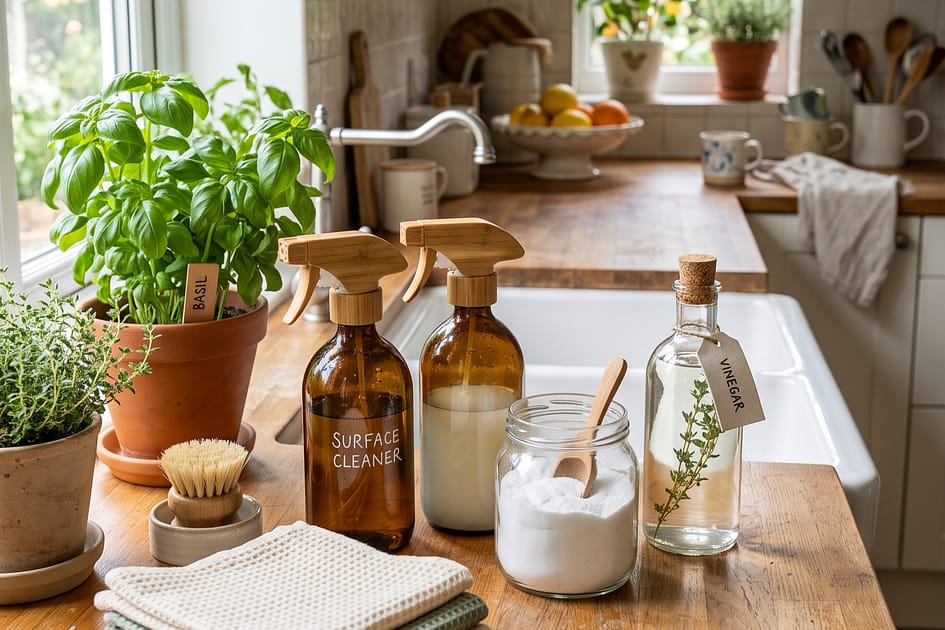
Once the disposable tools are sorted, the next biggest source of waste is the bottles themselves.
Keep your bottles and refill them
The simplest approach is to treat a good spray bottle as a long-term tool, not a throwaway. Keep one or two sturdy bottles and refill them from a larger container or a concentrate instead of buying a new one each time.
A few ways to do this:
- Buy refills. Some brands sell larger refill containers or pouches, which use less packaging overall than buying a new bottle every time. I’ve written about one example, a refillable natural cleaning spray, in my guide to eco-friendly cleaning products.
- Use concentrates. A small bottle or tablet that you dilute at home in a reusable spray bottle means you’re buying and transporting a lot less packaging and water.
- Use a refill store. If there’s a bulk or refill shop near you, you can often fill your own containers with dishwashing liquid, laundry liquid and all-purpose cleaner. My favourite refill store is Bin Inn.
Label your bottles clearly. Write what’s inside and, if you’ve diluted a concentrate, the ratio, using a waterproof pen or a simple label. It saves guessing, and it keeps things safe.
A note on safety
A few simple habits keep refilling safe:
- Never mix cleaning products unless the label says it’s fine. Mixing bleach with vinegar or with ammonia-based products can release dangerous gases.
- Don’t reuse food or drink bottles for cleaning products. Someone could mistake the contents for something drinkable.
- Keep everything out of reach of children and pets, and make sure each bottle is clearly labelled.
What about making your own?
Homemade cleaners using ingredients like white vinegar, baking soda and soap can be a good low-waste option for some jobs, and they’re cheap. But they’re not the only way to reduce waste, and they’re not for everyone. If you enjoy mixing your own, my DIY zero-waste cleaning recipes are a good place to start.
If you’d rather not, that’s completely fine. Refilling a bottle with a ready-made concentrate has the same waste-reducing effect, with none of the experimenting.
A few honest limits on the DIY route:
- Vinegar is a useful cleaner and deodoriser, but it isn’t a disinfectant. If you need to properly sanitise a surface, such as after handling raw meat, use a product that’s designed for that.
- Avoid vinegar on natural stone, like granite or marble, as it can dull and damage the surface.
- Baking soda is mildly abrasive, so it’s great for scrubbing sinks and pots but not for delicate surfaces.
The goal is a routine that works, not a purity test.
Step 4: Narrow down to products you’ll actually use
This is the part that makes a low-waste routine last.
Most of us don’t need a different product for every surface. A short, practical set usually covers nearly everything:
- An all-purpose cleaner for benches, tables, appliances and most hard surfaces.
- Dishwashing liquid (or a solid dish soap), which also works for general cleaning in a pinch.
- A bathroom cleaner or a scrub, such as baking soda paste, for sinks and showers.
- A glass cleaner, or simply a damp microfibre cloth followed by a dry one.
- Laundry and dishwasher detergent in the most low-waste format available to you, such as a refill, a powder in a cardboard box or a concentrate.
That’s it. If a product doesn’t earn a regular place on that list, you probably don’t need to restock it.
Buying fewer products also means fewer bottles, less to store, and less money spent on things that don’t get used. It’s one of the rare cases where the low-waste option is also the simpler one.
Step 5: Build a simple low-waste cleaning routine
A routine doesn’t have to be elaborate. Here’s a straightforward one you can adapt to your household.
Daily (a few minutes)
- Wipe the kitchen bench and stovetop with a damp cloth and a little all-purpose cleaner.
- Hang cloths to dry rather than leaving them damp in a pile, which helps stop them smelling.
Weekly
- Wipe the bathroom surfaces and give the sink and shower a quick scrub.
- Dust with a washable duster or a damp cloth.
- Mop or vacuum the floors.
- Wash your cleaning cloths with a hot-ish regular load.
Every month or so
- Check your bottles and refill anything that’s running low.
- Wash or replace anything that’s seen better days, such as your dish brush head or sponge.
- Reassess your short list. Are you using everything on it?
The trick is to make the low-waste option the easy option. Keep your cloths where you’ll reach for them, keep your refill bottles filled, and don’t keep the disposable versions within arm’s reach. When the old habit isn’t convenient, the new one wins surprisingly quickly.
Step 6: Handle what’s left over
Even with a good routine, some waste is inevitable. A few ways to deal with it well:
- Use worn-out cloths as rags for the dirtiest jobs, then bin them when they’re finished.
- Recycle empty bottles and containers where your local council accepts them. Check the numbers on the bottom and rinse them first.
- Compost compostable items, such as cellulose cloths and natural fibre scrubbers, where the label says it’s safe to do so.
- Dispose of unwanted chemical products responsibly, using a hazardous waste collection point, and never pour them into drains or waterways.
If you want a deeper look at reducing waste across the home, my beginner’s guide to eco-friendly living is a good next step.
Final thoughts
Sustainable cleaning isn’t about doing it perfectly. It’s about making a few changes that fit your life, so they actually last.
Frequently asked questions
Is a reusable cloth really better than a disposable wipe?
Over time, usually yes. A cloth that’s washed and reused hundreds of times replaces hundreds of single-use wipes. The exact benefit depends on how you wash it, but for everyday wiping, a reusable cloth is almost always the lower-waste choice.
Are refillable cleaning products worth it?
If you can access them easily, yes. Refills and concentrates use less packaging than buying a new bottle every time, and many work out cheaper per use too.
Do I need to make my own cleaning products to be low-waste?
No. Making your own is one option, but buying a refill or concentrate and keeping your existing bottle works just as well for reducing waste.
How often should I wash my cleaning cloths?
Wash them after each use if they’ve been used on anything particularly dirty, or weekly for general-use cloths. Make sure they dry fully between uses.
What if I can’t find refill options near me?
Start with the swaps that don’t depend on refills, like reusable cloths and washable mop pads. Then look at concentrates or tablets you can buy online, which many NZ retailers now offer.
Stay Connected!
Brought to you by Eco TIGA – Your Friendly Guide to Eco-Friendly Living
Affiliate Disclosure: Some of the links in this post may be affiliate links. This means if you click on the link and make a purchase, I may earn a small commission – at no extra cost to you. Rest assured, I only recommend products or services I truly believe in and think you’ll find valuable. Thank you for supporting ecotiga.com and helping me continue to provide helpful content.